This game works better with groups 30+. Gather a few different types of wrapped lollies and tape them under the chairs of your audience before the meeting. Keep in mind the different types, and the amount of lollies you use, so that the teams will be as evenly numbered as possible. Everyone looks underneath their seat, grabs the lolly, and then has to find the other people in the room with the same lolly. Once all team members have found their respective “gang”, they eat the lollies and turn the wrappers into team badges, and answer a few sharing questions.
Author: mikedicker
Guess Who
Everyone writes 3 or 5 little known things about themselves on a card with their name at the top of the card and gives them to the M.C. Each person in the group will need another piece of paper to write their guesses on. The piece of paper should be numbered down one side equal to the number of people in the group. The M.C. reads out the first card saying: “person one is…” and reads out the description. After time has been given for people to write their guess, the M.C. then reads out the following card “person two is…” and so on till all the cards have been read out. Who ever guesses the most right is the winner.
People Pictionary
Split the group into 2 teams, A and B. Everyone has to write down some things about themselves and what they like on a card that can be used as clues in a game of Pictionary (eg. For Mike – a motorbike, drums etc.). The leader of the game then calls up the first delegated drawer from each team and shows them a card from a person on the opposite team, they go back and try to draw the clues on a piece of paper so their team can guess who it is. When the team has guessed, another drawer runs up to the game leader to grab another card from the opposite team and so on until the team to guess all their cards first is the winner. It will be important for the cards to have a name on them so the drawer will know if their team’s guess is the right answer.
Hot Chocolate
Get together the four ingredients you need to make hot chocolate ie. Mugs, spoons, packet of hot chocolate mix, and marshmallows (make sure you provide hot water and milk). Divide everybody into four even groups. Give each group only one hot chocolate ingredient and enough for each person in the group to have 4 each. Group 1: each person is given 4 mugs. Group 2: each person is given 4 spoons. Group 3: each person is given 4 marshmallows. Group 4: each person is given 4 packets of hot chocolate mix.
Once all the ingredients are handed out, get everybody to form new groups that have all the hot chocolate ingredients. There should now be newly formed groups of 4 people which now have enough hot chocolate ingredients to make one cup of hot chocolate for each person in the group. When each group has made their hot chocolates ask them to sit down and give a sharing question for them to discuss.
Variations of this mixer could be: Banana splits (bowls, bananas, chocolate toping, ice cream), spiders (glasses, ice cream, soft drink, spoon/straws), Milo (glasses, Milo, spoons, milk), the list goes on and on…
Note: Allow at least 25 minutes for this mixer.
Appointments
Each person in the group is given an appointment card – that is: a card which has space for 3 names on separate lines (with 1 extra line underneath each name) and 3-4 sharing questions at the bottom or reverse side of the card. Give everybody time to go and make an appointment with someone else in the group.
Make it very clear that appointments are with each other (ie. if person x makes an appointment with person y, then person y also makes an appointment with person x).
Allow about 10 seconds for each appointment to be made and then have everybody sit down (or you may want to sing a song or do something else). Then when you’re ready say “it’s now time for your first appointment!”. Everyone in the group goes to their first appointment and asks the other person the 3-4 sharing questions written on the appointment card. Allow about 2-3 minutes for each appointment and then finish the mixer by asking some in the group to share who the met and the answers to the questions.
Secret self-portrait
Each person in the group is given a piece of A4 paper and a pen or pencil. Each person draws their own self portrait without showing anyone else their drawing, and adds one unknown fact about themselves. The activity leader collects the portraits and then randomly redistributes the unnamed portraits to the group (if anyone gets their own they should choose again). Everyone in the group then tries to find who the self portrait belongs to. A name is placed on the portrait once the subject of the portrait has successfully been found, and then put up on the wall.
Secret portrait
The group sits in a circle. Write everybody’s name on a piece of paper and place the names in a hat or bowl. Give each person a piece of A4 paper and a pen or pencil. Each person draws a name from the hat or bowl – they are not to tell anyone whose name. When everyone has a name, they draw the face of that person without anyone knowing who they are drawing. When every one has finished drawing, the activity leader collects the portraits and shows them to the group one at a time while the group tries to guess who the subject of the portrait is and who drew it.
Portrait Bingo
Give each person a ‘Bingo sheet’ – a piece of paper with a 6 squares big enough to draw a small portrait. Write a question for each square. The goal of the game is to find someone who can answer the question or statement in the box (eg. Someone who went to the beach in the holidays, someone in year 7, someone who has a dog etc). when you’ve found someone who fulfils the category, you draw their portrait in the square provided, then move onto another person. You can’t have the same person again on your bingo sheet.
Speed Meeting
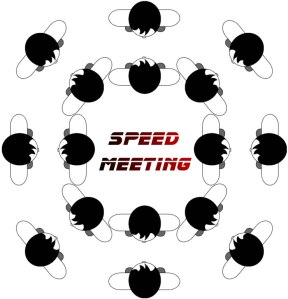
Like speed dating. Split the group into 2 equal groups. Have the groups stand in two concentric circles with the outside circle facing in and the inside circle facing out, each person should be facing a partner. Give the group 3-4 questions to ask each other (ie. Name, place you were born, what’s 3 things you’d take into the Big Brother house? Etc.). The partners have 2-3 minutes to ask the questions and find out the answers before the leader of the activity rings a bell (or similar) and the partners must change (ie. Inside circle moves one person to the right or outside circle moves two people to the left, etc.). Repeat the process till everyone has met each other or till time allows. Select people to share with the group who they met and the answers to the questions.
Note: This activity requires a bit of room.
Find your twin
This game is played in rounds, and in each round members of the group need to find their twin and ask 3 or 4 set questions. The leader of the activity gives direction for how each person is to find their twin in each round ie. Round 1- find someone the same height as you, round 2- find someone who is in the same year at school, round 3- find someone who like the same type of music, etc. When everybody has found their twin they ask each other the 3 or 4 set questions (ie. What’s you’re name? How would you spend your last $10.00? What’s the best thing about youth group? Etc.).
Variation: Swap.
After finding you’re twin and asking the questions for that round, swap one item with each other (ie. shoe, sock, necklace, hat, keys, etc.) and then move on to the next round. At the conclusion of all the rounds you should have a collection of items from the people you met. Ask a few people in the group to stand up and share what items they have, who they’re from, and the answers to the questions, then return the items to their owners. After a few people have shared, make sure everyone returns the items.
Skittles Mixer
Pass the bag of skittles around so students can take a handful skittles. Each person can eat their skittles but has to keep one skittle left over. Each colour (normally 5 colours in a skittles bag) represents a different question (ie. Green- What do you want to be when you grow up? Red- last part of the Bible you read or heard? Orange- Sing a verse of your favourite TV show theme song. Purple- What is your favourite subject in school and why? Yellow- how many people in your family). Go around the group as each person answers the question that corresponds to their colour skittle. After they have answered the question, they can of course eat their skittle.
30+ Note: If there’s more than 30 people then just let people keep one colour skittle only. Ask everyone with that colour to stand but only pick 3 to answer the question.
Fongo Bingo
(from the famous James Fong!)
Each person is given a piece of paper and a pen. Everybody is given about 5 minutes to go around the room and collect the names of 6 people in the room they don’t know so well. They must find out 3 things about each person on their sheet (eg. Name, school, about family, pets, worst hair cut, etc.). When everybody has 6 people on their sheet they take their seats again and we play Bingo! The leader up the front will have a list of everybody in the room and their names (if you don’t have a roll, you will need to collect everyone’s names as the enter). To play bingo the leader up the front will read names of the sheet in a random order. People tick off the names on their sheet as they are read out. Whoever is the first to tick off all 6 of the names on their sheet and yell Bingo! Wins. That person will receive a prize and should be asked to introduce all 6 people on their sheet and say what they found out about them.
40+ Note: If there’s more than 40 people then reduce the number of names you need to make bingo (eg. Gather 6 names but you only need to tick off 3). This increases the odds and shortens the game.
Bible Taboo
This is a rip off of a popular board game Taboo. Make a bunch of cards that have Bible characters or recognisable Bible things (eg. Noah’s ark, temple, Ark of the covenant, etc.) and list about five words on the card that can’t be used to describe the person or object (Taboo words). Split the group into teams and have each team taking turns at going through the cards and trying to describe the Bible character or thing to their group. 1 pt. per correct guess to that team, and -1 pt. if that team takes a pass on a card or says one of the Taboo words.
Note: I’ve done this game with 120 teenagers and it works a treat!
Here is a pdf of Bible Taboo cards (email me if you want the Word doc.)
JUST ADDED! A pdf of the Bible Taboo Cards in Deutsch (German)!
** If you like this, you might also want to check out:
- Guess Who? Bible Characters (personal favourite!)
- Don’t Forget the Bible Verse (with powerpoint file)
- The Hit List
- Bible Charades/Pictionary
- Scattagories
Props
Taken from the theatre sport game show “who’s line is it anyway?”. Split into 2 or more teams of 3-5 people and give each teams a set of props (eg. broom, cushion, hat, hula-hoop, brick, aqua noodle, etc…). Give each team 5 minutes to come up with as many Bible stories as possible which they can act out in 30 second skits using the props. Have the teams perform in front of a judging panel (probably made up of leaders) and score each skit on: Use of props; team participation; comedy value, paraphrased biblical accuracy etc… Rotate through the teams as they perform their skits. If a story is acted out by more than one team then the points for that 30 second skit are halved.
30+ Note: If there are 30 people or more, then give each team a Bible story and let them find a way to work the props into the story (could use broom as a horse etc…). The groups will need time to read the story and prepare a skit, at least 10 minutes for prep and 2 minutes to perform. Depending on the number of groups this activity may take about 30 minutes.
Here is s clip of the ‘props’ activity in action at salt youth group petersham:
A Perfect Match
This game takes a lot of preparation!
Pick some famous couples from the Bible (eg. Samson & Delilah, Mary & Joseph, Ruth & Boaz, Abraham & Sarah, David & Bathsheba, etc. Or some famous groups of people from the Bible, eg. Shadrach & Meshach & Abednego, the 12 sons of Israel, 12 disciples of Jesus, etc.) and create some information sheets about them (including details of where you’d read about them in the Bible, who they are, their role in the salvation story of the Bible, and some prayer points to thank God for). Here is a link to an online dictionary of bible characters that is very useful. Put up the information sheets about the Bible characters on the walls around the room.
Create some sticky name labels for each name in the famous couple or group (eg. a label for Samson and a label for Delilah etc.) and distribute the labels randomly to each person. Give everybody 5 minutes to check out the information sheets and discover who they are and who their match is (eg. If it’s “Samson” they need to find “Delilah”). Once everybody has made their match and formed their pair or group, they sit together with the info sheet and talk about what they discovered about their bible character and then pray the prayer points. Bring everybody back together and pick some people to share who they were and what they discovered.
Note: Even if people have little or no Bible knowledge they should be able to work it out from the info sheets.
Bubble Gum Sculpture
This is a good revision game, but you’ll probably only want to do this once a year… it’s pretty gross. You will need rubber gloves and lots of bubble gum. Divide kids into groups. Give each group a plate or flat dish and 3 or 4 packets of bubble gum. In 10 minutes each group needs to chew their bubble gum and make a sculpture out of the gum that relates to a Bible story or teaching point from past weeks (or that night). Warning: it smells pretty bad and rubber or latex gloves are a must!
Variation: Can do with play-doh for something less gross…
Don’t forget the bible verse!
A version of the TV game show “Don’t forget the lyrics!”. This game is played in teams. Read out a verse in the Bible and leave off the last few words. Tell the contestants how many words are missing and the contestants have to guess what the missing words are. You can play this game in rounds ie. New Testament verses, Old Testament verse, Obscure verses (for more points), Well Known verses (less points), and you can have rounds where the number of missing words increases each round. The aim of this game is to teach Bible verses and significant points of Biblical theology.
Here’s an example: Mark 10:43 Jesus said “whoever wants to become great among you must ___ /_____ /_________” (be your servant). We might expect that whoever wants to be great must be the smartest or have the best skills, but Jesus says be a servant, and that’s a significant theological point for Christianity.
You can find a list of good Bible verses at the back of “Changing the World through Effective Youth Ministry 2” K. Moser, Aquilia Press, 2005.
-40 Note: This game works best with a maximum of 4 groups of 10 people… otherwise it takes too long and there’s too much down time for other groups while they wait for their turn.
Here’s 2 versions of the game in powerpoint (.pptx)
 (x) christian (m) ministry (2) to (y) youth