Why does Jesus teach in parables?

What is a parable? A parable is a story that teaches us something about God, his kingdom, and ourselves. They can often be a bit confusing, and sometimes hard to understand.

So why did Jesus teach in parables? Matthew 13:11-16 gives us the answer. Jesus quotes from Isaiah 6:8-9

“He replied, “The knowledge of the secrets of the kingdom of heaven has been given to you, but not to them. 12 Those who have will be given more, and they will have an abundance. As for those who do not have, even what they have will be taken from them. 13 This is why I speak to them in parables:

“Though seeing, they do not see; though hearing, they do not hear or understand. In them is fulfilled the prophecy of Isaiah: “‘You will be ever hearing but never understanding; you will be ever seeing but never perceiving. For this people’s heart has become calloused; they hardly hear with their ears, and they have closed their eyes. Otherwise they might see with their eyes, hear with their ears, understand with their hearts and turn, and I would heal them.’

But blessed are your eyes because they see, and your ears because they hear.”

Jesus Teaches in parables to separate those who have ears and those who have not. This is a figurative way of saying “those who want to know about God’s kingdom, those who want to learn from Jesus will be able to understand what these parables are saying because the knowledge of the secrets of the Kingdom of Heaven have been given to them. But those who do not want to know about God’s kingdom or learn from Jesus just won’t get it… even what they know will be taken away from them, so that even though they have ears – they won’t be able to hear; and even though they have eyes – they won’t be able to see… because they have hardened their heart against Jesus.

This is a hard teaching but we can see the truth of it. Why is it when we tell our friends about how much God loves them and how much Jesus cares for them, the just don’t get it? It’s because the do not want to know about God’s kingdom, they do not want to learn from Jesus. This doesn’t mean that we shouldn’t bother telling them about God’s kingdom and king Jesus (Jesus persisted in teaching those who wanted to hear and those who didn’t), but it does mean we shouldn’t be surprised when people seem to miss the good news.

Parables are hard work. But… when we put in the effort to understand them, what we learn about God, his kingdom, and ourselves is truly worth the effort. If you can read the parables of Jesus, learn from them, and be changed by them, then “blessed are your eyes because they see, and your ears because they hear.” The secrets of the kingdom of God have been given to you.

Bible Spot

This segment is an opportunity for people to share with the group what they’ve been reading in the Bible lately and what challenges and/or encouragement they’ve received from reading the Bible. This segment can be done spontaneously or someone may be notified before hand to do a Bible Spot. After someone has done a Bible Spot, prayer for them in the group.

Spotlight

This segment is about getting to know a member of the group more intimately. Have every body stand up and then begin a process of elimination through statements ie. sit down if you have blue eyes, sit down if you have enclosed shoes, sit down if you are in year 8, etc. when there is only one person left standing, ask that person to stand in front of the group on a chair and then ask them a series of questions that help the group know them better. Start off by asking general information questions (ie. Name, school, age, etc.), and follow withy some light hearted questions (ie. If you ran off to join the circus what type of entertainer would you be?), and then finish with some deeper questions (ie. What’s the best thing about being a Christian? Etc) obviously, if you’re not sure whether they are Christian or not use appropriate alternatives (ie. What’s one question you’d like to ask God?).

Testimony

This segment is for sharing someone’s personal faith journey with the group. Can be done impromptu or prepared. It’s good to mention 3 elements in a testimony:

  1. Where you’ve come from? (how you became a Christian?),
  2. How you’re life is changed now? (what’s it like being a Christian at the moment?), and,
  3. Where are you going? (where is you’re Christian faith leading you?).

Always, a testimony needs to focus more on Jesus rather than the sins you’ve left behind.

AAPB

The good old Australian Anglican Prayer Book (AAPB) has some great prayers written in it for various things on pages 91-97 (also p.120). Doing some of these every now and again is a good way to be trained in WHAT to pray and different things to pray for. The leader of the prayer time can print some off (or photocopy) a few of the different prayers and choose some of the youth group to pray them out. Some of the language might need to be adjusted and updated so the youth group understand it.

Here is a word document of the AAPB prayers with language adjusted to be gender inclusive.

Represent

Have individuals in the group share a time during the week when they’ve been able to represent (or fly the flag for) Jesus. I could be something like not gossiping while all your friends were or supporting scripture at school by turning up or telling someone about Jesus. Cheer and encourage those people that share their ‘represent’ and pray for the group to represent Jesus where ever we are, and in every situation.

Voice

Being a voice for those people who don’t have one. A focus spot on social justice near and abroad. A range of topics from persecuted Christians to undeveloped countries, and corrupt political leaders, are just some ideas of what can be covered. Include practical suggestions on what can be done or is being done about the situation so that the youth group feels empowered to bring about change. Finish the segment with a prayer time for the country or situation that was being voiced.

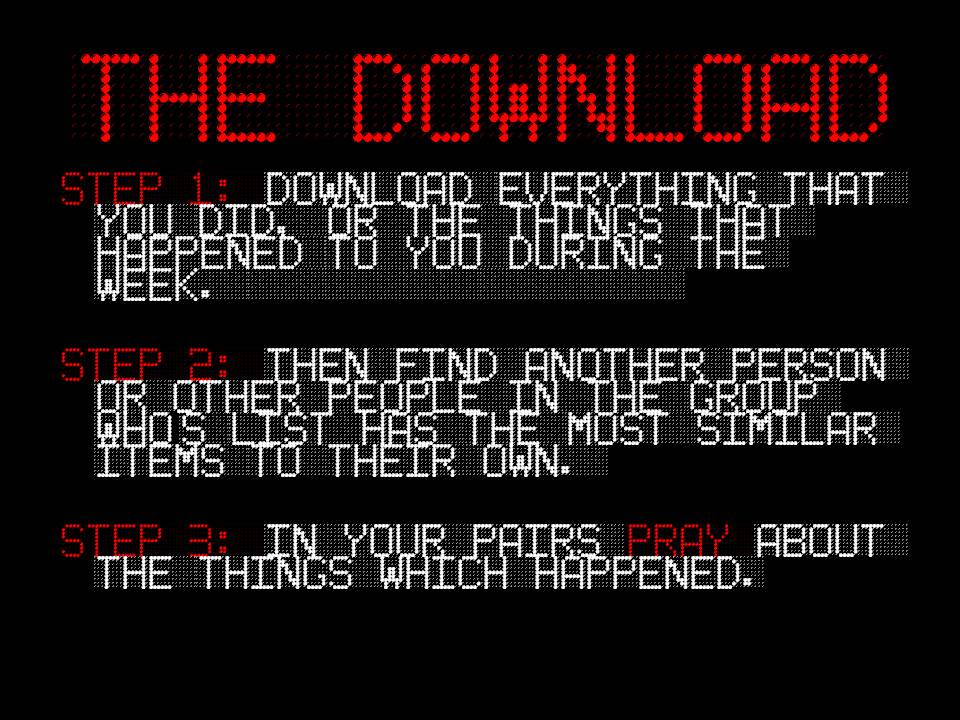
The Download

This share time is to give the group an idea of all the things that are happening in each others lives and some things to be praying for. Give each person in the group a sheet of paper and tell them to write down (download) everything that they did, or that happened to them during the week (or holidays). Whoever can write down the most gets to share their week with the group, and whoever has written the least. Choose 1 other person to also share their week with the group. Finish by praying for those 3 people.

Here’s a couple of slide images a friend of mine made for the activity:

the download  the download 2

Confession

To remind us of our sinfulness and the salvation we have through Christ Jesus. The first 2 orders of confession are taken from the AAPB.

#1: Take a moment for people to reflect on their lives and pray this confession silently using the singular personal pronouns “I” and “me” and “my”. Then after a few minutes pray this confession together as a group using the plural personal pronouns “we” and “our” and “us”.

Most merciful God, we humbly admit that we have wandered from your way: we have done wrong, and we have failed to do what is right. You alone can save us.
Have mercy on us: wipe out our sins and teach us to forgive others. Bring forth in us the fruit of the Spirit that we may live as disciples of Christ. This we ask in the name of Jesus our Saviour. Amen.

Have someone declare God’s forgiveness:

God wills that all people be saved and in response to his call we acknowledge our sins. He pardons those who humbly repent and truly believe the gospel. Therefore we have peace with God, through Jesus Christ, to whom be all blessing and honour forever. Amen.

#2: Read out Mark 12:28-33 (the greatest commandments) and give people time to reflect on how they have kept or rather, no kept these great commands. Then confess together:

Almighty God, Father of our Lord Jesus Christ, maker of all things, judge of all people, we acknowledge with shame the sins we have committed, by thought, word, and deed, against your divine majesty, provoking most justly your wrath and indignation against us. We earnestly repent, and are heartily sorry for all our misdoings. Have mercy on us, most merciful Father. For your Son our Lord Jesus Christ’s sake forgive us all that is past, and grant that from this time forward we may serve and please you in newness of life, to the honour and glory of your name, through Jesus Christ our Lord. Amen.

Have someone declare God’s forgiveness:

Almighty God our heavenly Father, who of his great mercy has promised forgiveness of sins to all who with hearty repentance and true faith turn to him: have mercy on you; pardon and deliver you from all your sins; confirm and strengthen you in all goodness; and keep you in eternal life; through Jesus Christ our Lord. Amen.

#3: Use the psalms of confession: Psalm 6, 32, 38, 51, 103, 130, 143. Perhaps read one and then have each person write a confession of their sins on paper and then burn them up in a fireplace as symbolic of how God has dealt with our sin, or even write them in the sand at a beach and let the ocean wash them away…

Reflection Section

Reflecting on the Bible teaching. First get people to think about the Bible teaching and how it would particularly impact their life: something they may need to change, repent of, confess, or something they could start doing. Get them to write a short prayer to God about their reflection. Some people will feel more comfortable doing this by themselves, others will prefer to discuss personal application in small groups, so make it clear that those people who would like to discuss it in a group should form a group and those who would rather do it individually can do so by themselves. Give this segment about 5 minutes. (obviously this will need to come after the Bible teaching).

Victories and Arrows

This is an opportunity for the youth group to notice the hundreds of victories over temptation and sin that they have everyday, and also to identify the “flaming arrows of the evil one” (Eph. 6:16) that we face and how we might avoid/deal with them. Run this segment by getting everyone into groups of 2-3 people and give them a bit of paper. Give them a couple of minutes to reflect and then get them to write or draw their victories on one side of the paper, and the “flaming arrows” (temptations and distractions they face) on the other. Finish by sharing some of them with the larger group and then the leader should pray that we would continue to grow in faith, and Jesus’ victory over sin.

SMS Memory Verse

Write the memory verse out on a piece of paper using only the numbers used to write the words in an SMS message, ie. the numbers that correspond to the letters on the keypad. (Eg. “843 5673” = “the lord”). Obviously there will be a number of words that will correspond to a pattern of numbers but that’s all part of the fun for the kids to work out the memory verse. They can use their mobile phones for this game to help them work it out. Split the group into small teams of 3-4 and if there is a person on each team who has credit and is willing to spend it, then you could say whoever is first to text the memory verse to the leader’s mobile wins. Otherwise the winner can be whoever is first to decode it and write it out correctly.

Mad Gab Memory Verse

This is a good game for introducing a new memory verse. Just like the card game ‘Mad Gab’ from Mattel©. It’s a game of words and phrases, it’s not what you say, it’s what you hear. Say the words “Day Leo Fur Rings” a few times and you’ll find you’re saying. “daily offerings!”, just sound it out. Write up the memory verse in Mad Gab style (eg. “Iron hot ash aimed off day goes bell” = I am not ashamed of the gospel). If it’s a large memory verse split it into sections (ie. If there are 3 sections to the memory verse then make 3 rounds to the game, and when a team has solved the first section, give them the second, and so on til they solve the whole verse). Players work in teams and compete against each other to solve the memory verse first, and when they have solved it, run up to the white board and write it out in full.

Buzzer Blanks

(AKA. Wheel of fortune, missing letters, hang man) This is a good game for introducing a new short memory verse. Using a white board, put underscore dashes on the board for every letter in each word of the memory verse eg. Jesus wept = _ _ _ _ _    _ _ _ _. Divide everybody into 2 groups. Each group elects someone to be the buzzer and another to be the contestant. The ‘buzzer sits on a chair out the front while the contestant stands behind them with their hands on the head of the buzzer, when they want to answer a question they lightly press the buzzer to make the sound for that team. The game is played in rounds so that the each person in the team has an opportunity to be the buzzer or contestant. When a contestant gets a question right they are allowed to select 1 letter of the alphabet (apart from vowels) to be uncovered on the board. Have special rounds where contestants are allowed to choose vowels or solve the memory verse. You will need to prepare at least 26 questions for the game and they can include bible questions, youth group questions, celebrity questions, etc.

Pass the Parcel

Hide a word of the memory verse in each layer of the parcel (with or without prizes). With music playing, pass the parcel around the group till the music stops and then unravel a layer of the parcel. Repeat till all layers are unravelled and all words have been revealed. Have the group place the memory verse in order and say out lout together.

Note: If you have lots of people, this activity will require lots of space.

Eat Out! Memory Verse

Write each word of the memory verse on a disposable paper bowl (one memory verse word on each bowl, or if it’s a long verse write a few words) so that there is a set of bowls with the complete memory verse. Split into teams of about 5 people and give one set of bowls to each team (obviously you’ll need to have one full set of bowls with the memory verse written out per team; eg. 5 teams = 5 sets of bowls). Have each bowl filled with some sort of food (eg. Cereal, crumbled dry weet-bix, chips, custard, etc.) so that the word/s cannot be read underneath. Do a “ready, set, go!” and the team that finishes their food first, arranges the memory verse in proper order, and read it out is the winner.

Warning: You will want to check for food allergies among the contestants first, and let people sit out who really don’t want to be a part of it.

Balloon Darts

Print off 2 copies of the memory verse on different coloured paper and put the words of the memory verse into about 5-6 balloons. Blow up the balloons and stick them to the wall. Split the group into 2 teams and give them some darts. The teams won’t know which balloons will have their memory verse words in it. When all the balloons have been popped, the first team to arrange the memory verse and read it out is the winner.

Warning: Don’t let kids go up to the wall until all the balloons have been popped and no one is throwing any darts.

Chinese Whispers

This operates just like the Chinese whispers you played at school. Split into 2 teams and have each team form a circle or a line. Tell the memory verse to the first person in the group and then they have to pass it on to the next person by memory, and so on… At the end of the group, see who has the memory verse most accurate. This activity will work as an introductory memory verse activity as well.

20+ Note: If you have more than 20 people, split into smaller groups and have the last person in the group write out the verse on butcher’s paper.