
Here is 5 youth Bible studies on the book of Hebrews.
It is free to download and use for any ministry purpose but not for any commercial gain.
(Links to the file on Dropbox)

Here is 5 youth Bible studies on the book of Hebrews.
It is free to download and use for any ministry purpose but not for any commercial gain.
(Links to the file on Dropbox)
My senior minister and I haven’t ever sat down and designed a grand master plan for an integrated church with children’s and youth ministry, but what we have had is a continuing and developing conversation about how our church practice can integrate people across generations and, by extension, integrate the full diversity of people. This is what we mean by an integrated church: how our church practice can integrate people across generations.
It’s a conversation that was born out of studying youth ministry at Youthworks College and out of a wholehearted commitment to continually reflect upon the consistency between our theological principles and church practice.
Overtime, it has become apparent that there are three theological convictions that have particularly helped in reforming our church practice towards being an integrated church:
It’s been hard to apply what this will look like in our context at All Saints Petersham, but we’ve tried to be creative, to reflect and critique and make adjustments as we’ve gone along. For example, some concrete application of this conversation has been to:
All of these applications have their limitations and challenges and are part of the process of critique and adjustment.
This is actually a journey that the good people of All Saints Petersham have tacitly been on together in the last 10 years, and the experiment continues.
What is left for us to do is articulate the theological underpinnings for an integrated church, starting first with the issue of integrating people across generations and then extending and applying the theological framework beyond our generational diversity to include other human particularities (e.g. people affected by chronic disability, mental illness, addiction, poverty etc.)
The following three blog posts will follow the titles of the three theological convictions that have particularly helped in reforming our church practice towards being an integrated church:
Hopefully these blog posts will also be informative for you as you work out and reflect upon your theological principles and church practice, not least that we might do youth and children’s ministry in a way that honours God, builds his kingdom and is biblically and theologically faithful.
There will be discussion questions at the end of each post for your own reflection or comment.
Mike.
If you chose the “Bible Focus” youth ministry model based on your theology, values and principles (part 1), and you’ve recruited the right leaders and have the systems in place to look after them (part 2), and have designed a program that looks after your families (part 3), and have structured your regular youth group gathering and how put it together (part 4a & part 4b), then step 5 is to start some regular mid week Bible study groups for your young people.
These groups form the back bone of youth ministry and you should strongly encourage every teenager to attend a group for the year. It’s a great mix of bible study, social activity, accountability, and fun, but on a more personal level than the main youth group gathering. The groups are user friendly, and a great place to invite friends!
My experience has been that we get more young people attending weekly Bible study groups than we get at the main weekly youth group gathering. It’s also the place where our young people invite most of their non-Christian friends. That might seem a little counter intuitive given that it’s a small group of young people meeting together around the Bible, but I think that’s the appeal! It’s a smaller group of people and therefore somewhat less intimidating for a newcomer, it provides a more intimate and personal setting to ask questions and explore the Bible, and it’s not just for Bible study but also for sharing life together and building friendships.
You can organise a weekly Bible study group in any way you choose, but here’s a couple of tips:
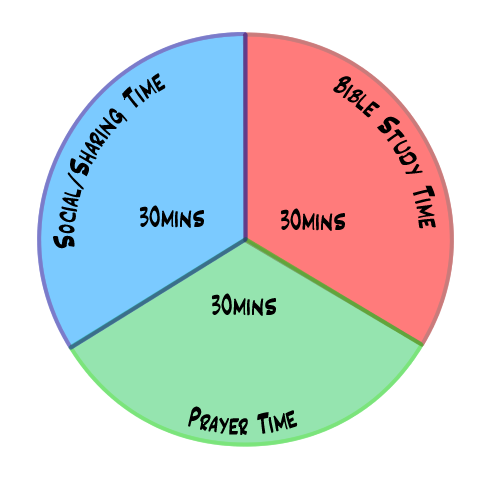 components to arrange your Bible study group time roughly into thirds, let’s say 30 minutes for each component with a total Bible study group time of 90 mins. 90 minutes is long enough to cover the essentials and shorter enough to not be a weekly burden on the family time of young people.
Here’s some great resources for weekly Bible study groups:
 “Leading Better Bible Studies” by Rod and Karen Morris
 “Studies 2 Go” by Julie Moser and
  “More Studies 2 Go” by Julie Moser
If you chose the “Bible Focus” youth ministry model based on your theology, values and principles (part 1), you’ve recruited the right leaders and have the systems in place to look after them (part 2), and you’ve designed a program that looks after your families (part 3), then as a continuation of structuring your regular youth group gathering (part 4a), this step 4(b) focusses in on The how of youth group gathering and activities.
It can be quite an exhausting task coming up with a new youth group program for each school term of the year and trying to be creative with how you do your youth group gathering so it remains fresh and yet faithful to your theology, values and principles at the same time. So here’s a few tools I use to make the process a little more simple, less exhausting and more sustainable.
We use this table (below) as the framework for each of our term programs. All the rows down the left represent the weeks and dates of the school term to be programmed. All the columns across the top represent the segments that make the weekly youth group gathering. The essentials are Bible Teaching and Prayer (see the previous post on this: structuring your regular youth group gathering), but we have also added: Bible Game/Mixer, Sharing Time, Memory Verse, and Supper. We also have a youth group band and do singing at our youth group but they have a separate roster that complements the term program. The other columns, as you can see, are for things like teaching theme, special notes, and who’s doing what.

These regular segments at our regular youth group gathering mean there is an element of comfortable predictability for our young people as they come to youth group week after week, and yet because the segments are done with different activities each week and are arranged in a different order most weeks, there’s an exciting element of unpredictability that keeps it fresh. The advantage of this predictable structure is that young people know what they’re inviting their friends and gain confidence in the youth group gathering and what they can expect to happen when their friends are there.
The term program really starts at the beginning of the year when I put together the year’s teaching program (2005-2012 examples here) and then at the start of each school term I put the term program together by slotting in that term’s teaching program and then fill out the rest if the table by inserting the various activities which are found on this website (download the complete segment activities document here). In the Game/Mixer column I try to have a mix of Bible games and mixer games throughout the term so we’re doing activities that help us learn about God and each other throughout the whole term – these are 2 main aims of Games/Mixers in our regular youth group gathering and they provide another layering of Bible teaching that is creative and enjoyable. Ultimately I try to pick activities for all the segments that will dovetail well with the teaching or create a good spread of variety over the term.
Once the term program is complete, it is then up to the MC (one of the youth group leaders) to put together a running sheet of how those segments will be arranged for the gathering and to nominate/ask other leaders to run those activities. ALl the leaders know what is expected of them at any given youth ministry gathering because of the “Leader Expectation & Leader Roles” documents here.
Below is an example of a running sheet for week 1 using the above example term program (you can download the running sheet template as a Word document on the Download page). You can see how the various segments have been arranged and delegated to different leaders. Each segment has the description of how it’s run cut from the segments.doc (here) and pasted into the right hand column of the running sheet so that everyone knows what they’re doing and when.

You’ll notice that there are other elements in my example term program and running sheet which I haven’t described. We’ll get to these later when we talk about how to include young people in serving at your youth ministry (that’s what the Salt VII is about) and how to partner with parents and families as they raise their children in the Christian faith.
You’ll also notice that there are activities included in the program and running sheet which aren’t listed on this website or in the segments.doc, and that’s because these are things which have to do with our youth ministry context and history and aren’t universally applicable. You get the general gist though right?
These tools are not meant to be rigid expressions of what a regular youth group must be like but a helpful tool in getting yourself started off in a good direction.
The next post is “How to start a youth ministry from scratch! (Part 5): Organising weekly youth Bible study groups
If you chose the “Bible Focus” youth ministry model based on your theology, values and principles (part 1), and you’ve recruited the right leaders and have the systems in place to look after them (part 2), and have designed a program that looks after your families (part 3), then step 4(a) is to structure your regular youth group gathering.
The first image that usually pops into someone’s head when the term “youth group” or “youth ministry” is mentioned is that often chaotic gathering of overly energetic, socially awkward, and sexually frustrated teenagers on any given Friday night of school term… It seems inevitable that any gathering of young people will have to contain a mix of chaotic games (often messy) and activities that are thinly veiled attempts to make teenagers flirt with each other for the entertainment of the onlookers (E.g., “Honey if you love me give me a smile“, “Straws and Rubber bands“, etc). But the good news is it doesn’t have to be that way!
Because young people are people first, and they need what all people need – the transforming power of God’s Word in his son Jesus by the Spirit -then the regular youth group gathering should be centred around God’s Word. This is why the aims of a “Bible Focus” type of youth ministry are:
This is really about your theology of church, what you believe Christian gathering is all about, what Christians do when they’re gathered together, and why they meet in the first place. If you don’t know what your theology of church is, here is a really helpful place to start: www.bettergatherings.com.au (and you can have a crack at this article if you want to be pushed a little further: “knoxrobinson-for-today“)
While you work out what your theology of Christian gathering is, I think a good biblical and simple working definition is “God’s people gathered around His Word“. This means that your Sunday church meetings, your Bible study groups, your kid’s club, and your youth group all count as type of Christian gathering if their primary purpose is to meet around God’s Word, that is, to know him in the way he reveals himself by his Word and ultimately in the “Word made flesh” – Jesus. A Christian gathering is a representation of the heavenly church and should contain the things that Christians do when they gather:
A Christian gathering doesn’t have to look like a typical Sunday church service, and given that young people are open to experimental learning, you should take the opportunity to be creative with how the Bible is taught and how you create the opportunities to share the Christian life together, to know each other better and encourage one another. This website is an attempt to share some of the creative ways that you can do these various components of Christian gathering: Resources Link.
The Christian gathering isn’t limited to these components/segments of Bible Teaching, Singing, Prayer, Sharing Life, and Fellowship over Food. Apart from Bible Teaching and Prayer, it’s not necessary to either have all of them or be limited by just these, having a regular memory verse time is quite a good addition for example.
Of course, there’s now a big question pushing it’s way into your mind isn’t there…?
If the main youth group gathering is ordered around Christian gathering then what about non-Christian young people?
Excellent question! Here you need to go back to your foundational theological principles. You chose the “Bible Focus” type of youth ministry because you want kids to know and trust Jesus & adopt his values. Because you believe this can only happen by God’s Word. And because you want kids to “do life” with Jesus and see what this looks like in practice. These are not merely discipleship reasons but missional ones too! The wise Jodie McNeill calls this “Dual Action“. What he means by this is that you can disciple people and mature them in the Christian faith while evangelising and gospelling non-Christians at the same time, it doesn’t have to be either one or the other.
The Christian church has actually been operating this way for millennia. (you can skip this next little indented bit if you don’t care for the Biblical references)
The Bible paints a picture of God’s people as a diverse community of believers (Rev. 7:9-12) united in the cross (Gal. 3:26-29; Col. 3:11; 1 Cor. 12:12-13) with each member of the body of Christ gifted to build each other up into the whole measure of the fullness of Christ (cf. Rom. 12:4-8; 1 Cor. 12:12-27). Therefore, the first priority of the church is to maintain the fellowship (Eph. 4:1-6), and edify the community of believers (1 Cor. 14:4-5, 12, 17, 26), as Jew and Gentile, Slave and Free, and Young and Old relate to each other by their common unity found in Jesus.
The function of the community of believers is to be both passive and active in evangelism. Passively, the church is a light to the world (Matt. 5:14-16), a witness to the world and heavenly principalities through their unity and gathering in Christ (John 17:20-2; 1 Cor. 14:23-25; Eph. 3:8-10). Actively, the church is to continue the apostles commission in bringing the good news of Jesus to “all nations” (Matt. 28:18-20; Luke 24;47; Acts 1:8). It is in this way that the church exercises the ministry of God’s Word to it’s members and the world.
The main youth group gathering can do the same.
Of course, the criticism is that young people won’t come along to youth group that is all about God, Jesus and the Bible.
Perhaps that’s true enough. The world is, not surprisingly, quite resistant to the message of the gospel, and as much as people like the idea of Jesus (like Ghandi) they don’t like him to tell them what to do. But the answer is not to then try and coax in non-Christians with worldly bait so you can then gently introduce a very other-worldly way of life (this is often the trick of the salesman “free hotdog and drink if you come to our store on Saturday”). The world doesn’t need the church to mimic the worldly ideas of what a fulfilling life is (but with a much poorer budget and minus the sex and alcohol).
No, the answer is to hold out a way of life that the world will not and indeed cannot offer. The world needs the church to be the church, the bride of Christ, the members of his body. The world needs the church to proclaim the gospel and teach the Word of God in all it’s fullness. The world needs to see Christians gathering together because of their common unity in Jesus and not because of their common age or race or gender.
It’s for this reason that I believe it’s important that the main youth group gathering include both junior and senior high age young people and both genders because young people, like all people, need to learn the value of loving and relating to those different to them in age, sex, taste etc., and junior high age young people need to have senior high age young people to look up to. My aim is to never split them no matter how much we grow in number and especially no matter how much the senior high might complain about the immature juniors or the juniors complain about the boring seniors, if anything that’s the perfect reason to keep them together!
Surely when a non-Christian young person (or any person) walks into this type of Christian gathering they will be like the unbeliever in Corinth who sees God at work in His people gathered around His Word and exclaims “God is really among you!” (1 Cor 14:24-25).
This post is continued in How to start a youth ministry from scratch! (Part 4b): The how of youth group gathering and activities
I love it when people ask me how our youth ministry is going, and although I usually give them some numbers to demonstrate that we’re growing numerically, it just doesn’t seem to capture what we’re really most concerned about. I don’t what to get caught in the numbers game (and the bragging!), I want to be able to say that there is significant spiritual growth in our ministry, that people are trusting the Lord Jesus more and more, but how do you measure spiritual growth? Or perhaps measure is not the right word (that sounds little scientific and mathematical) perhaps the question is better phrased: how do you get an indication of spiritual growth?
Well, we used this survey (below) at our youth ministry recently and the results were revealing! I almost can’t believe that it has taken me this long to ask this question, and it was so successful in revealing the spiritual state of the young people in our ministry that this survey is going to be a biannual feature from now on.
It’s a simple survey with only 2 sections (and really only 2 questions).
The first and primary question is “Why are you a Christian?” (or not a Christian as the case may be for some). Please note that is it’s NOT “How did you become…” or “What do you believe…” as fascinating as those questions are, I want to know why you are following Christ today (or not).
The second question is about Bible reading. The logic is that to grow in relationship with God (grow spiritually) then you need to be spending time in His Word, hearing Him, knowing His character and values etc. In the attached survey that we used I was also trying to gather some extra specific data on their preference for reading the Bible alone or with others, but you may still find the info relevant and helpful for measuring the spiritual growth in your young people.
I knocked up this survey using Apple Mac Pages program (which I can send you if you like) but would only take you a minute to do it in Word and tailor it for your specific context (you’ll notice it’s not fancy!).

 (x) christian (m) ministry (2) to (y) youth